

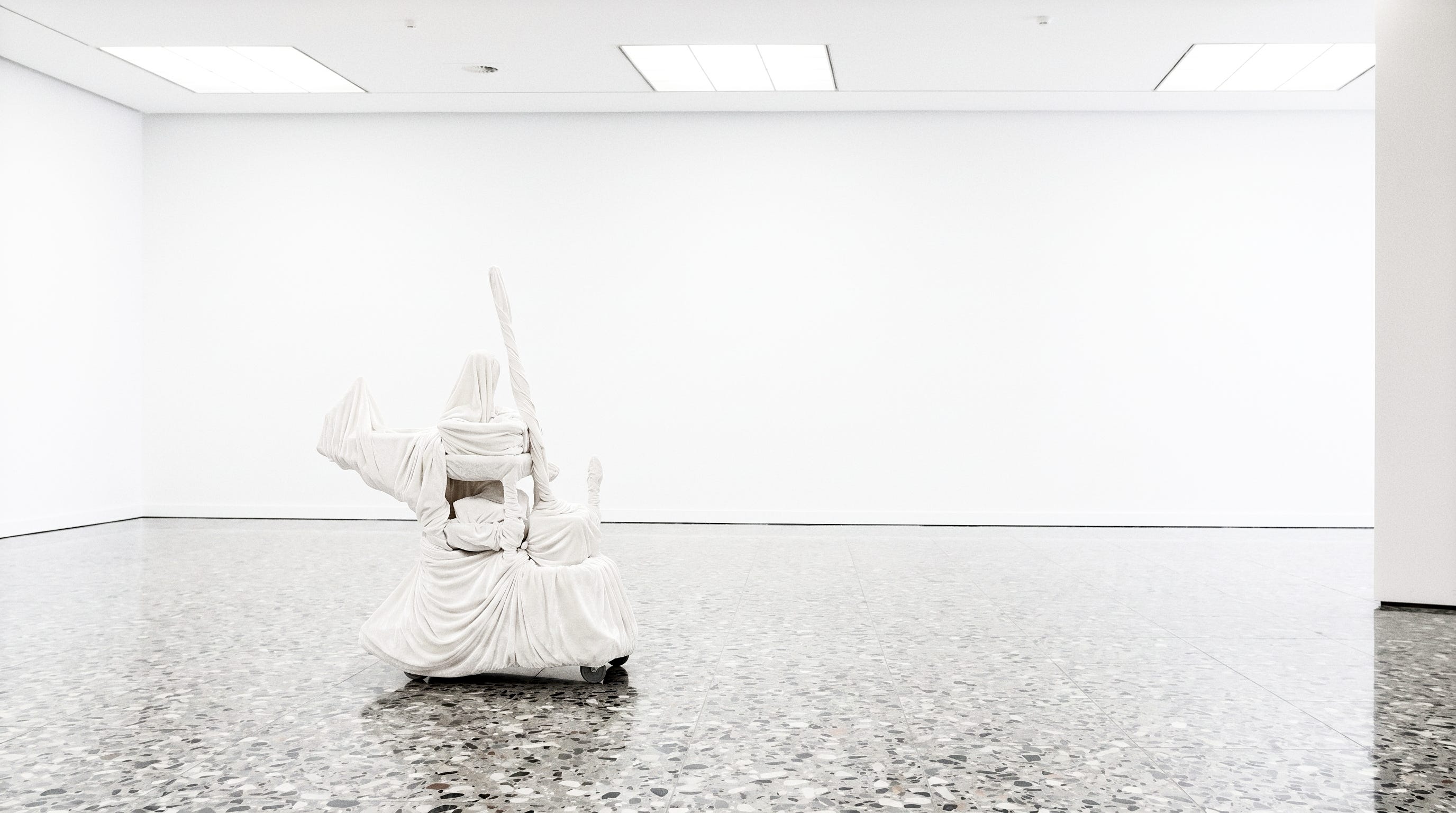
Every picture the studio releases is two objects wearing one file name. The lowercase one, image, is the artefact: pixels, paper, a thing with edges. The capital one, IMAGE, is the perception: what the artefact is understood to be, by whom, from inside which world. The first can be made in an afternoon. The second is constructed the way institutions are constructed, slowly, with intent, mostly out of sight. The thesis spells the word twice because the trades are different.
In August 1911 a Louvre handyman walked the Mona Lisa out of the building under his smock, and attendance went up. Parisians queued through the Salon Carré to look at four iron pegs and a rectangle of discolored wall; the crowds included Kafka. More people came to see the absence than had ever come for the painting. The IMAGE had detached from the image completely and was outdrawing it at its own address. Perception is not a shadow the artefact casts. It is a separate body with its own mass, and given the chance it will exhibit alone.
A century of theory worried that mechanical reproduction would wither the aura of the work. The generative age ran that experiment at industrial scale and the result came back inverted. When the artefact became infinitely producible, the aura did not thin out; it condensed into the only scarce object left standing. Anyone can now make the image. The margin, all of it, lives in the IMAGE.
An IMAGE cannot be prompted. It is built from the room around the picture: the world the picture claims to come from, the sequence it arrives in, what is withheld alongside it, who is allowed to feel addressed. The artefact is one exposure of that world. Change the world and the same pixels change meaning, which is why a photograph can be worthless on one feed and inevitable on another without a single edit in between. The studio makes pictures, and that is the smaller half of the job. The larger half is authoring the conditions under which the pictures cannot be read any other way.
We create what people can’t have, and the phrasing is precise. The picture they can have; a file moves at the speed of theft and we price that in. What cannot be taken is the position the picture speaks from. Right-click a specimen out of a constructed world and you receive the image, entire, and the IMAGE stays home. It was never in the file.
There is a line in the studio’s own archive, older than its current voice: desire lives in the gap between. The sentence never finished. It names no objects, and I used to read that as a draft. It is the completed thought. Desire is gap-shaped, and the gap between image and IMAGE is where it lives, and the studio’s actual instrument is the width of that gap: close it and the work collapses into information, open it too far and the work drifts into noise. Held at width, it runs like a current. The thesis spells the word twice and puts one character between them. The ampersand is the studio.